Overview
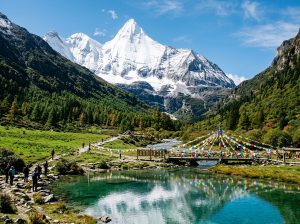
Daocheng Yading is the most celebrated trekking destination in Sichuan, and the reason is simple: three 6,000-metre peaks standing close together above glacial lakes, alpine pasture and forest, in a landscape that Tibetan Buddhists have regarded as sacred for centuries.
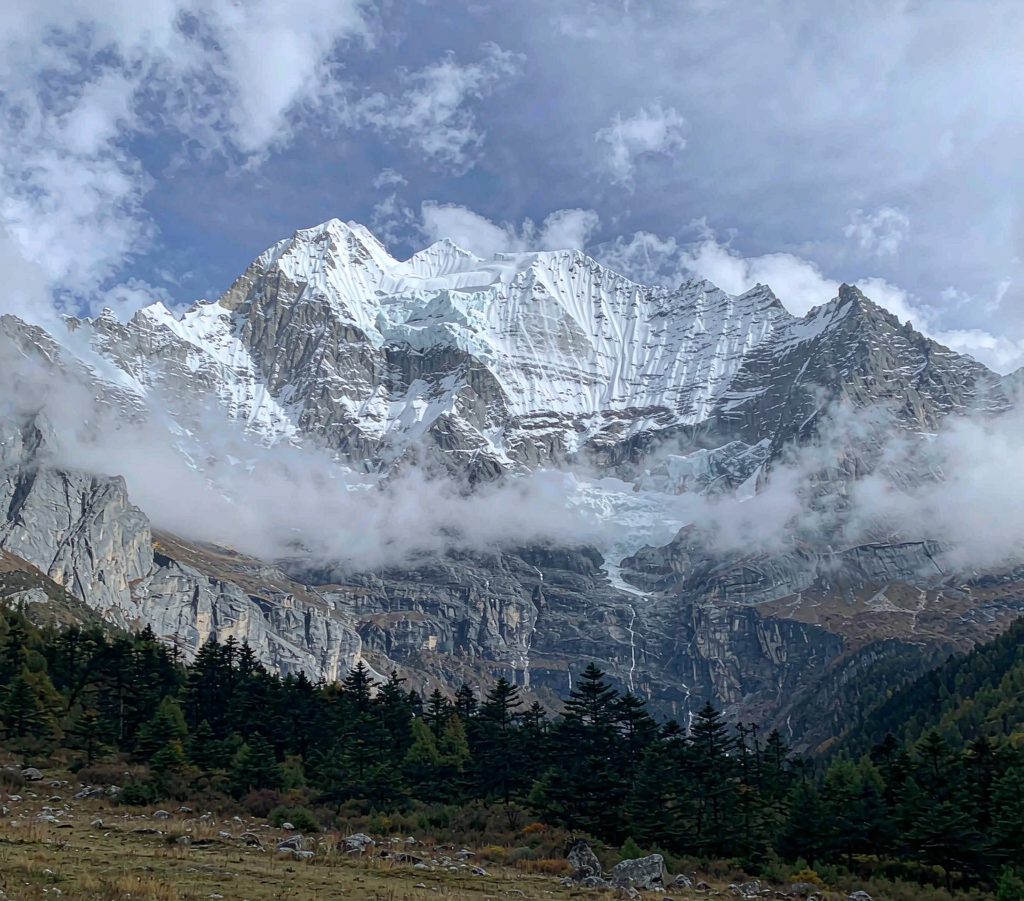
The three peaks — Chenresig (6,032 m), Jambeyang (5,958 m) and Chanadorje (5,958 m) — are the manifestation of the three bodhisattvas of compassion, wisdom and power, and the entire area is a pilgrimage circuit. The route takes you through the Luorong pasture and up to the Five-Colour Lake and Milk Lake at 4,600 metres, past the Chonggu Temple and along the kora beneath Chanadorje.
This is a serious altitude trek. You spend five days above 3,700 metres and the highest walking is at 4,700. The itinerary includes a night in Daocheng and a night in Riwa to acclimatise before the main walking days, and your guide carries oxygen and a pulse oximeter throughout. The walking itself is on good paths, but it is long and the altitude makes everything harder.
It is worth it. There is nothing else in China quite like it.
- The three sacred peaks of Chenresig, Jambeyang and Chanadorje in one valley
- Five-Colour Lake at 4,600 m, its bed of mineral deposits shifting colour with the light
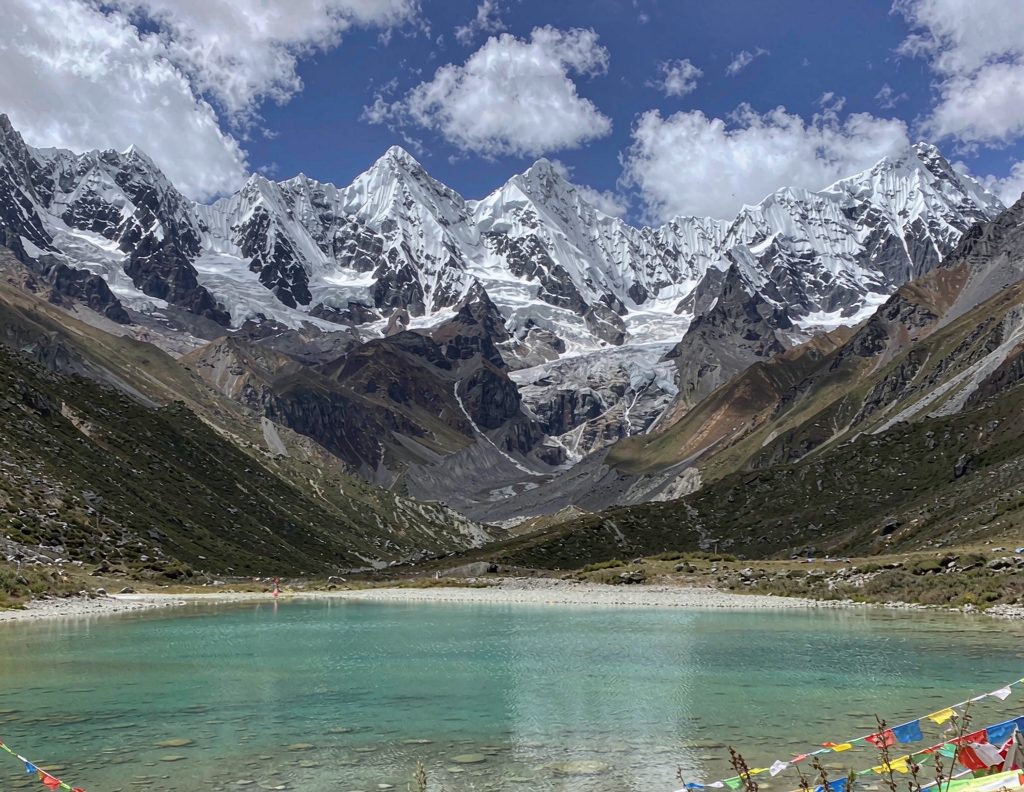
- Milk Lake, a turquoise glacial tarn ringed by white scree
- Luorong pasture and the prayer-flag passes above it
- Chonggu Temple at 3,880 m, the starting point of the pilgrimage kora
- Two nights of acclimatisation before the main walking days
- Tibetan villages, mani stones and the plateau's big empty skies
Itinerary
-
1 Chengdu to Daocheng via the Plateau
Dinner Daocheng, 4-star hotel (3,750 m)Early morning: Transfer to Chengdu airport for the flight to Daocheng Yading — around 65 minutes, and the fastest way onto the plateau. If the flight is unavailable on your dates, we drive, which takes two days via Litang and is a spectacular overland route in its own right.
Morning - Arrival at Daocheng Yading airport: At 4,411 metres, this is one of the highest airports in the world, and stepping off the plane is your first experience of the altitude. Take it extremely slowly — walk at half your usual pace, carry nothing heavy, and do not bend over for longer than you have to.
Afternoon - Transfer to Daocheng: Around an hour down to the county town at 3,750 metres, which is where you will spend the night. Lower is better for sleeping.
Evening: A light dinner and a briefing on the days ahead. Your guide checks everyone's oxygen saturation and explains the symptoms that matter: persistent headache, nausea that does not pass, and a cough that will not stop. Any of them and we descend.
Important: This is the hardest day of the trip for most people, and it involves no walking at all. Acclimatisation is the work.
-
2 Acclimatisation: Daocheng & the Red Grassland
Breakfast, Lunch Daocheng, 4-star hotel (3,750 m)09:00 - A gentle day: Deliberately light. You will feel considerably better than yesterday, and the temptation is to do too much. Resist it — the next four days are at higher altitude still.
10:00 - Sangdui Red Grassland: A short drive out of town to a wetland where a species of red-tinted grass covers the ground in September and October, set against poplars and the plateau behind. It is a gentle first outing at around 3,900 metres.
12:00 - Lunch in Daocheng.
14:00 - Tibetan village: A visit to a nearby village — whitewashed stone houses with carved window frames, mani stone piles at the crossroads, and the family altars that are the centre of every Tibetan home. The Daocheng valley has been farmed for more than a thousand years and the villages here are working ones.
17:00 - Rest: Back to the hotel. Your guide confirms the next day's plan and the weather, and hands out any altitude medication that is needed.
Important: Drink two to three litres of water today. It makes a measurable difference tomorrow.
-
3 On to Riwa & the Chonggu Temple
Breakfast, Lunch, Dinner Riwa or Yading village, guesthouse (3,800 m)08:00 - Departure: A two and a half hour drive south to Riwa, the settlement at the entrance to the Yading nature reserve, at around 2,900 metres — the lowest sleeping point of the trip and a useful place to spend a night.
11:00 - Into the reserve: We take the park shuttle from the visitor centre up the valley to Longlongba, then a short walk or battery cart to the Chonggu Monastery at 3,880 metres.
12:00 - Chonggu Temple: A small monastery directly beneath Chenresig, the highest of the three sacred peaks at 6,032 metres. The monastery is modest; the setting is not. The meadow in front of it is the trailhead for both of the main walking routes, and the view straight up the valley at the peak is the image that Yading is famous for.
13:00 - Lunch: Simple, near the monastery.
14:30 - Short walk: An easy two-hour out-and-back along the valley floor toward the Zhuoma La Zhui, at a gentle pace, purely to test how everyone is coping at 3,900 metres before tomorrow's longer day.
17:00 - Check in at Riwa or in Yading village.
Evening: Dinner and an early night. Tomorrow is the biggest day.
-
4 The Long Route: Milk Lake & Five-Colour Lake
Breakfast, Lunch, Dinner Riwa or Yading village, guesthouse (3,800 m)07:00 - Departure: The big day. The long route runs from Chonggu up the valley to the Milk Lake (Niunai Hai) at 4,600 metres and on to the Five-Colour Lake (Wuse Hai) at 4,700.
08:00 - The climb: From the monastery the path climbs steadily through rhododendron scrub and then open scree, gaining 700 metres over around five kilometres. Horses are available for the lower half and are worth considering. The last kilometre is steep, on loose stone, and at this altitude it takes a long time. Everyone walks at their own pace and your guide stays with the slowest.
11:00 - Milk Lake: A glacial tarn of an extraordinary opaque turquoise, ringed by white marble scree, directly beneath the east face of Jambeyang. The colour comes from finely ground rock flour suspended in the meltwater.
12:00 - Five-Colour Lake: A further 30 to 40 minutes up, at 4,700 metres. The lake is shallow and its bed is composed of mineral deposits that shift between blue, green, yellow and brown as the light and the angle change — hence the name. This is the high point of the trip in every sense.
13:30 - Descent: Back down the same path, which is harder on the knees than the ascent. Around three hours.
17:00 - Return to the guesthouse: Dinner, and the satisfaction of the hardest day done.
Important: This is a long day at serious altitude — roughly 12 kilometres and 900 metres of ascent, with the highest point at 4,700 metres. If anyone is struggling, the turnaround is at the Milk Lake and that is a perfectly good day.
-
5 The Short Route: Luorong Pasture & Chanadorje
Breakfast, Lunch, Dinner Riwa or Yading village, guesthouse (3,800 m)07:30 - Departure: A shorter day, and a beautiful one. The route from Chonggu runs through the Luorong pasture, a broad alpine meadow grazed by yaks and horses, with the peak of Chanadorje — the bodhisattva of power, 5,958 metres — filling the head of the valley.
09:00 - Gongga Lake: A small lake in the forest at 4,100 metres, holding a clear reflection of Chenresig on calm mornings. The path to it is level and easy.
10:30 - Luorong pasture: The meadow opens out, and from its upper end you get the full view of Chanadorje's sheer granite north face. Prayer flags are strung across the pasture, and the yaks and horses grazing in it belong to the Tibetan families who summer here.
12:00 - Lunch: At the pasture, or back at Chonggu if the weather closes in.
14:00 - Return: Down through the forest to Chonggu and back to the guesthouse, arriving mid-afternoon. The rest of the day is free — most people sleep.
Evening: A final dinner on the plateau. If the sky is clear, the Milky Way from Riwa is extraordinary, because there is no artificial light within a hundred kilometres.
-
6 Return to Daocheng & Departure
Breakfast Not included08:00 - Departure: The drive back north to Daocheng, around two and a half hours.
11:00 - Daocheng: Depending on your flight, a short visit to the Daocheng White Pagoda — a large Tibetan stupa on the edge of town, surrounded by a kora of prayer wheels that locals walk every morning.
12:30 - Lunch in Daocheng.
14:00 - Departure: Transfer to Daocheng Yading airport for your flight to Chengdu, arriving the same afternoon, or overnight in Daocheng and fly out the following morning.
Practical note: Flights from Daocheng are weather-dependent and cancellations are not unusual, particularly in winter. We strongly recommend keeping a buffer day in Chengdu at the end of this trip before any onward international connection.
Gallery
What's included
- 5 nights at hotels and guesthouses (Chengdu or Litang, Daocheng, Riwa, Yading)
- Daily breakfast plus 4 lunches and 3 dinners
- English-speaking guide experienced at altitude
- Private 4WD vehicle with driver for the plateau roads
- All entrance fees, park shuttle buses and the Yading battery cart
- One-way or return domestic flight Chengdu-Daocheng where the schedule allows
- Oxygen canisters, pulse oximeter and altitude medication carried throughout
- Trekking poles and rain ponchos
- Airport and station transfers
Not included
- Flights and trains to and from Chengdu
- Most dinners
- Travel insurance — must cover altitude evacuation above 4,000 m
- Tips for guide and driver
- Personal expenses and hotel incidentals
- Porter service and horse riding within Yading