Overview
This is the trip people save up for. Eight days from Lhasa to the north side of Everest, crossing the Tibetan plateau on the Friendship Highway, with the Potala Palace, Yamdrok Lake, Gyantse's Kumbum stupa, Shigatse's Tashilhunpo Monastery and the Rongbuk Valley along the way.
The last stretch is the reason. From Tingri the road climbs to the Gawu La pass at 5,219 metres, where on a clear day you look along a 180-degree sweep of the Himalaya and see five of the world's fourteen 8,000-metre peaks in one view: Everest, Lhotse, Makalu, Cho Oyu and Shishapangma. Then you descend to Rongbuk and Everest Base Camp at 5,200 metres, standing beneath the north face at sunset and again at sunrise.
It is a physically demanding trip because of the altitude, not the walking — most of it is by vehicle, and the exertion is in acclimatising. The itinerary is built around that: two nights in Lhasa before anything, a gradual climb, and a rest day built in. Your guide carries oxygen and a pulse oximeter throughout.
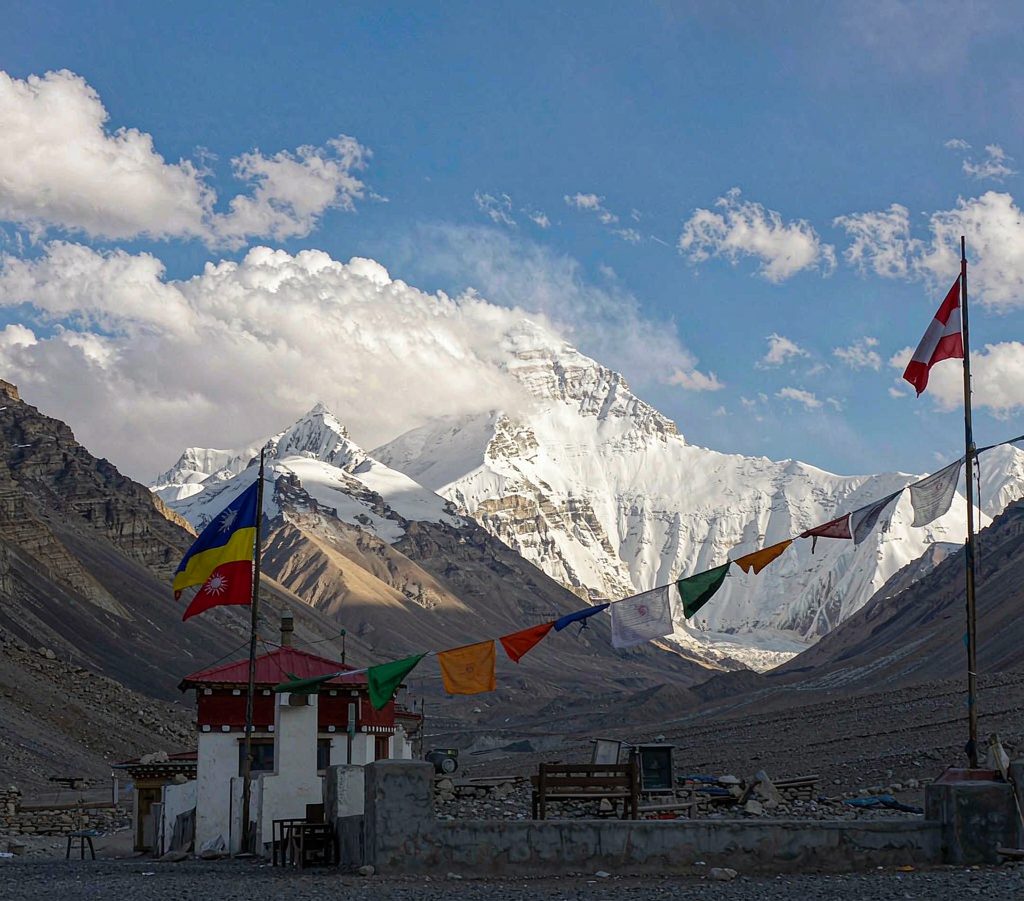
- Sunrise and sunset on the north face of Everest from Base Camp
- The Gawu La pass at 5,219 m with five 8,000 m peaks in one view
- Rongbuk Monastery, the highest monastery in the world at 4,980 m
- Potala Palace, Jokhang Temple and the Barkhor pilgrimage circuit
- Yamdrok Lake and the Karo La glacier
- Gyantse Kumbum, the largest stupa in Tibet, and Shigatse's Tashilhunpo
- Two acclimatisation nights in Lhasa before the climb
Itinerary
-
1 Arrival in Lhasa & Acclimatisation
No meals Lhasa, 4-star hotelAfternoon: Your guide meets you at Lhasa Gonggar airport — a 60-kilometre transfer at 3,650 metres along the Yarlung Tsangpo — or at Lhasa railway station if you have taken the Qinghai-Tibet Railway.
Late afternoon: Nothing is scheduled. This is deliberate. Altitude affects almost everyone to some degree on the first day, and the single most effective response is to do nothing at all. Check in, drink water, and rest.
Evening: A light dinner at the hotel. Avoid alcohol, avoid exertion, and go to bed early.
Important: Do not plan to walk the Barkhor this evening no matter how well you feel. Your guide will check on you and take your oxygen saturation with a pulse oximeter, and again in the morning. Headache, nausea and poor sleep are normal on the first night and are not themselves a reason to worry — but tell your guide about them.
-
2 Lhasa: Potala Palace & Jokhang Temple
Breakfast Lhasa, 4-star hotel09:00 - Potala Palace: The winter palace of the Dalai Lamas and the defining building of Tibet — 117 metres tall, thirteen storeys, more than a thousand rooms, built on Red Hill from 1645 under the Fifth Dalai Lama over the remains of a 7th-century fortress. The White Palace held the administrative and living quarters; the Red Palace holds the stupas of eight Dalai Lamas, the largest of them the Fifth's, which is fourteen metres high and said to contain 3,700 kilograms of gold. Entry is timed and the staircases are steep, so we go slowly.
12:30 - Lunch near the palace.
14:00 - Jokhang Temple: The spiritual heart of Tibetan Buddhism, founded in the 7th century to house the Jowo statue of the Buddha brought to Lhasa by the Chinese princess Wencheng. This is the building every Tibetan pilgrim comes to, and the approach is crowded with people prostrating themselves full-length on the flagstones in front of it, over and over, for hours.
16:00 - Barkhor circuit: The pilgrimage route around the Jokhang, walked clockwise by an unbroken stream of people, with prayer wheels along its length and the market stalls filling the side lanes. Allow an hour and a half, and go with the flow.
Evening: Rest. Two nights in Lhasa before the climb is essential, and you will feel the difference tomorrow.
-
3 Drepung & Sera Monasteries
Breakfast Lhasa, 4-star hotel09:00 - Drepung Monastery: Once the largest monastery in the world, with up to 10,000 monks in its 1950s population, founded in 1416 on the slopes below Mount Gephel. Around 700 monks live here now. The assembly hall, the debating courtyard and the whitewashed monks' quarters climbing the hillside give the best sense of what a Tibetan monastic city actually was.
12:00 - Lunch.
14:00 - Sera Monastery: Founded in 1419 and famous for its debating courtyard, where monks gather in the afternoon — usually from 15:00 to 17:00, though it is not held every day — and argue points of doctrine in a formalised, physical style: a question asked with a stamp of the foot and a clap of the hands, and the answer demanded immediately. It sounds aggressive and is entirely good-natured. The monastery's sand mandalas and its hermitage above the valley are also worth the walk.
17:00 - Return to the hotel and rest before tomorrow's departure.
Practical note: Confirm with your guide that your Tibet Travel Permit and Alien Travel Permit are in hand — they will be, since they are needed for the checkpoints beyond Lhasa. Carry your passport with you at all times from here on.
-
4 Yamdrok Lake, Karo La Glacier & Gyantse
Breakfast, Lunch Gyantse, 3-star hotel or guesthouse08:00 - Departure: South out of Lhasa, climbing through the Yarlung valley.
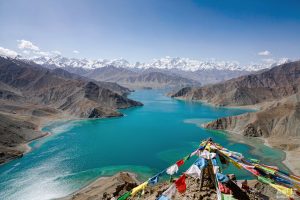
09:30 - Kamba La pass: At 4,794 metres, with the first view of Yamdrok Lake below — a startling turquoise snake of water twisting between brown mountains for 70 kilometres. Tibetans consider it one of the four holy lakes, and its colour comes from the mineral content of the meltwater feeding it.
10:30 - Yamdrok Lake: We descend to the shore for a walk along the water. The lake is fed by snowmelt and has no outlet; the colour changes with the light and the weather, and it is worth spending an hour rather than stopping for a photograph.
12:30 - Lunch in Nangartse, a small town on the lake road.
14:00 - Karo La glacier: A roadside glacier at 5,045 metres whose snout comes down to within a few hundred metres of the highway. The ice wall is several hundred metres wide, and the wind here is usually strong and cold. Prayer flags are strung across the slope below it.
16:30 - Gyantse: Arrival at 3,950 metres. Gyantse was the third largest town in Tibet and retains more of its pre-1950s character than almost anywhere else, with the restored Dzong fortress above the town and the Pelkor Chode monastery beside it.
-
5 Gyantse Kumbum & Shigatse
Breakfast, Lunch Shigatse, 4-star hotel09:00 - Pelkor Chode and the Kumbum: The Kumbum is the largest stupa in Tibet — a nine-tiered, 35-metre structure built in 1427 holding 77 chapels with around 100,000 images of Buddhas and bodhisattvas painted on their walls. It is a mandala in three dimensions, designed to be circumambulated floor by floor, and it is one of the great surviving works of Tibetan art. The murals are Newari-influenced and the skill is remarkable.
11:30 - Gyantse Dzong: The fortress above the town, shelled and captured by the British expedition of 1904 and partly restored since. From the ramparts the whole Gyantse valley is laid out below.
13:00 - Lunch in Gyantse.
14:30 - Drive to Shigatse: Around 90 minutes northwest along the Nyang Chu valley, at 3,840 metres.
16:30 - Tashilhunpo Monastery: Founded in 1447 by the First Dalai Lama and the traditional seat of the Panchen Lamas. It is the largest functioning monastery in Tibet, with around 800 monks, and its assembly hall, the Tombs of the Panchen Lamas and — above all — the 26-metre gilt-bronze statue of Maitreya, the future Buddha, are unmissable. The statue took 110 artisans four years to build and around 279 kilograms of gold.
Evening: Rest in Shigatse. The next two days are the highest of the trip.
-
6 Shigatse to Rongbuk & Everest Base Camp
Breakfast, Lunch, Dinner Rongbuk Monastery guesthouse or EBC tent camp07:30 - Departure: A long day — around 350 kilometres, most of it above 4,000 metres.
10:00 - Tingri: A military checkpoint and the turn-off for Everest. Paperwork takes a little time; carry your passport and permits ready.
11:30 - Gawu La pass: At 5,219 metres, the highest point of the road and the viewpoint that justifies the entire trip. On a clear morning the Himalayan range runs left to right across the whole horizon, and you can pick out five of the world's fourteen 8,000-metre peaks: Everest (8,848 m), Lhotse (8,516 m), Makalu (8,463 m), Cho Oyu (8,201 m) and Shishapangma (8,027 m). Your guide will point out each one, and the fact that you are looking at them from a roadside pass at the same altitude as their lower camps is not something you get used to.
13:00 - Descent to Rongbuk: The road drops to the Rongbuk valley and the monastery at 4,980 metres — the highest monastery in the world, founded in 1902, with a nunnery beside it and the north face of Everest filling the head of the valley.
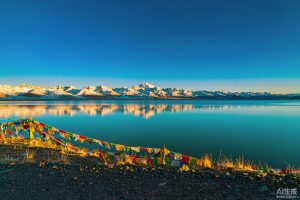
15:30 - Everest Base Camp: A further eight kilometres by shuttle bus or on foot to the tourist base camp at 5,200 metres, marked by a stone stele and a line of prayer flags. The mountaineers' base camp further up the glacier is closed to visitors, but you do not need to go closer: from here the north face rises more than 3,500 metres directly above you, and the scale is not something photographs convey.
18:30 - Sunset: If the sky is clear, the summit pyramid holds the last light long after everything around it has gone dark. Bring every layer you have — the temperature drops well below freezing within an hour of sunset.
20:00 - Dinner: Simple, at the monastery guesthouse or the tent camp. Accommodation here is basic: dormitory rooms or tents, shared facilities, no heating beyond blankets, and no running water. It is the highest night of your life and it will be a cold one.
-
7 Everest Sunrise & Return to Shigatse
Breakfast, Lunch Shigatse, 4-star hotel06:00 - Sunrise: Weather permitting, before dawn from the Base Camp or the monastery terrace. The summit catches the light first and the pyramid turns from grey to gold over about five minutes. Cloud is common in the morning, and if it is over, it is over — but you will have had the sunset, or you will get this, or neither, and there is no way to arrange it in advance. That is part of the deal.
07:30 - Breakfast.
08:30 - Departure: Back over the Gawu La pass in the morning light, which is often clearer than the afternoon, then the long drive back to Shigatse.
13:00 - Lunch en route.
17:00 - Shigatse: Arrival, and the first proper bed and shower in two days. This descent of more than 1,300 metres is the best thing that has happened to you all week, and you will feel it immediately.
Evening: A celebratory dinner, and sleep at a comfortable altitude for the first time in three days.
-
8 Return to Lhasa & Departure
Breakfast Not included08:30 - Departure: The drive back to Lhasa, around five hours, following the Yarlung Tsangpo valley northeast — a different road from the one you took out, through farming country and small towns that have nothing to do with tourism.
13:30 - Arrival in Lhasa: Drop-off at your hotel, or directly at Gonggar airport or the railway station if you are travelling the same day.
Practical note: Book onward flights no earlier than 17:00 on day eight. The road from Shigatse is subject to delays at checkpoints and unexpected roadworks, and there is no way to rush it.
If you are continuing by rail, the Qinghai-Tibet Railway to Xining is one of the great train journeys — 21 hours crossing the Tanggula pass at 5,072 metres, with an oxygen supply piped into the carriages. We recommend it highly and can arrange tickets.
Gallery
What's included
- 7 nights at hotels and guesthouses (Lhasa x3, Gyantse x1, Shigatse x1, Rongbuk or EBC x2)
- Daily breakfast plus 6 lunches and 2 dinners
- English-speaking Tibetan guide throughout
- Private 4WD vehicle with experienced plateau driver
- Tibet Travel Permit, Alien Travel Permit and all border permits
- All entrance fees listed (Potala, Jokhang, Kumbum, Tashilhunpo, Rongbuk, EBC)
- Oxygen canisters, pulse oximeter and altitude medication carried throughout
- All road tolls, parking and fuel
- Airport and station transfers in Lhasa
Not included
- Flights and trains to and from Lhasa
- Most dinners
- Travel insurance — must cover altitude evacuation above 5,000 m
- Tips for guide and driver
- Personal expenses and hotel incidentals
- Single-room supplement (higher in Tibet than elsewhere)