Overview
This is the journey that made Xi'an rich. The Silk Road ran northwest out of the capital along the Hexi Corridor, a narrow chain of oases between the Gobi Desert and the Tibetan plateau, and this six-day route follows it to the edge of the Taklamakan.
You begin with the Terracotta Army and the city wall, then take the high-speed rail west. Stops include Lanzhou on the Yellow River, the Great Wall's westernmost fort at Jiayuguan, and finally Dunhuang — where the Mogao Caves hold a thousand years of Buddhist murals, the Crescent Lake sits in the lee of the sand dunes, and the Yangguan pass marks the last Chinese outpost before the desert.
It is a long trip with real distance covered, but the high-speed railway does most of the work. Expect early starts, dry heat, and some of the most memorably empty landscapes in China.
- Mogao Caves — 492 surviving decorated grottoes of Buddhist art from the 4th to 14th centuries
- Sunrise or sunset over the Singing Sand Dunes and Crescent Lake
- Jiayuguan Fort, the westernmost stronghold of the Ming Great Wall
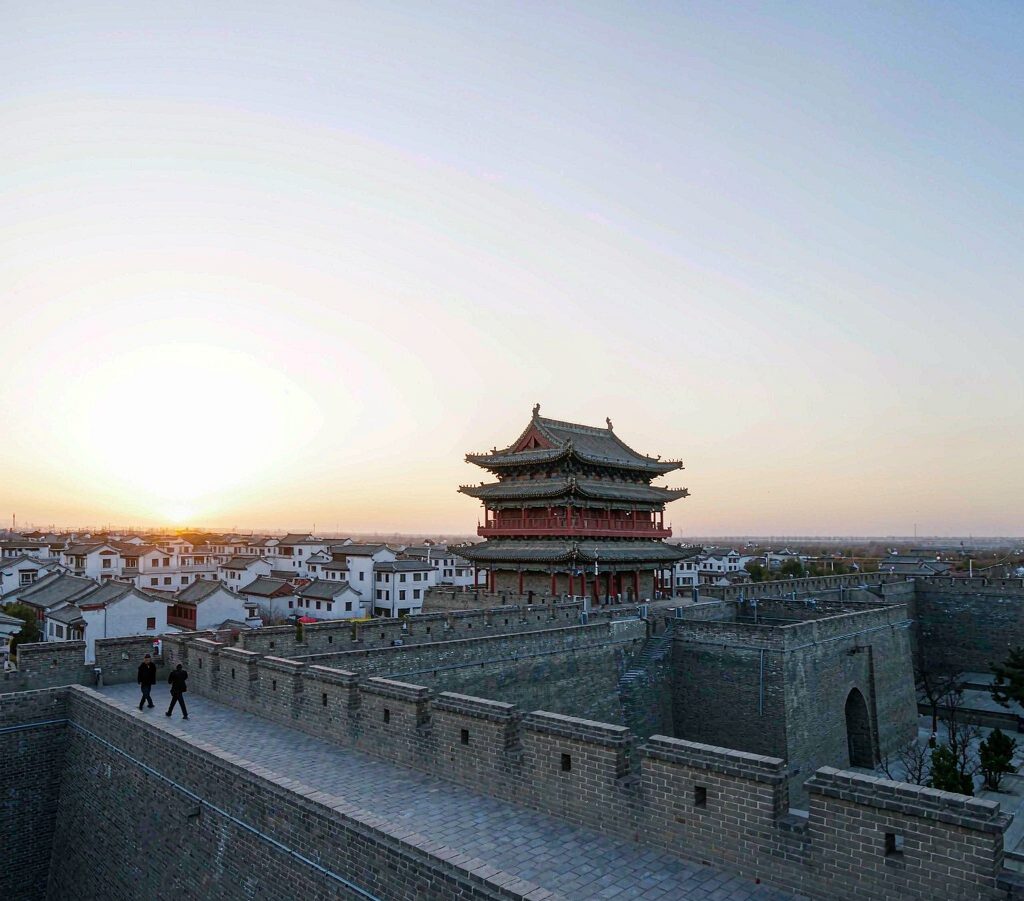
- Terracotta Army and Ming city wall of Xi'an
- Lanzhou's Yellow River waterfront and the Gansu Provincial Museum
- High-speed rail through the Hexi Corridor with desert views
- Yumen Pass and the Great Wall of rammed earth in the Gobi
Itinerary
-
1 Arrival in Xi'an
Dinner Xi'an, 4-star hotelAfternoon: Your guide meets you at Xianyang airport or Xi'an North station and transfers you to the hotel. If you arrive early, there is time for the Bell Tower and a first pass through the Muslim Quarter.
Evening: Welcome dinner in the Muslim Quarter — lamb skewers, biangbiang noodles and roujiamo. Your guide briefs the group on the week ahead: five cities, roughly 1,800 kilometres of railway, and a climate that gets drier every day.
Practical note: Please send passport details at least ten days before departure. High-speed rail tickets on the western lines sell out, and the Mogao Caves require advance reservation under a daily visitor cap.
-
2 Terracotta Army, then Rail to Lanzhou
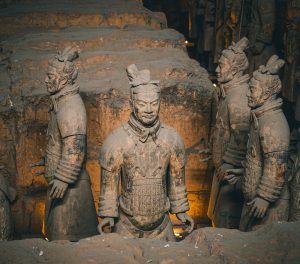
Breakfast, Lunch Lanzhou, 4-star hotel08:30 - Terracotta Army: A guided morning at the mausoleum of Qin Shi Huang. We cover Pit 1's infantry formation, the.command pit, the bronze chariot hall and the museum's explanation of the polychrome problem — the figures were painted, and almost all the pigment flakes within minutes of exposure.
12:30 - Lunch near the site.
14:00 - High-speed rail: Around three hours west to Lanzhou, the capital of Gansu, following the Wei River valley out of the loess hills.
17:30 - Yellow River waterfront: Lanzhou is the only city the Yellow River flows directly through, and the riverside park with its water wheels and the statue of the Yellow River Mother gives you the measure of it — this is the river that made Chinese civilisation and drowned it repeatedly.
Evening: Lanzhou beef noodles (lamian) for dinner — hand-pulled in front of you, and the reason most Chinese people have heard of this city.
-
3 Gansu Museum, then Rail to Jiayuguan
Breakfast, Lunch Jiayuguan, 4-star hotel08:30 - Gansu Provincial Museum: The Silk Road galleries here are outstanding, with Han dynasty bronze cavalry, Buddhist manuscripts from Dunhuang, and an excellent explanation of how the corridor was supplied and defended.
11:00 - High-speed rail: Around four hours northwest along the Hexi Corridor to Jiayuguan. The landscape through the window does most of the work — irrigated oases giving way to gravel desert, with the Qilian mountains snow-capped to the south.
15:30 - Jiayuguan Fort: The first pass at the western end of the Ming Great Wall, built in 1372 and known as the Impregnable Pass Under Heaven. The rammed-earth walls, watchtowers and the lonely Overhanging Great Wall section a few kilometres north are among the most atmospheric fortifications in the country precisely because nothing much has happened here for six hundred years.
Evening: Dinner at a local restaurant; the northwestern cooking here shifts toward lamb, cumin and wide hand-pulled noodles.
-
4 On to Dunhuang & the Singing Sand Dunes
Breakfast, Lunch, Dinner Dunhuang, 4-star hotel08:30 - Drive to Dunhuang: Around four hours by road, or by high-speed rail where the schedule allows, crossing desert that once took camel caravans weeks.
13:00 - Arrival and lunch.
15:00 - Mogao digital exhibition centre: Dunhuang strictly limits daily visitors, so the visit is structured: first a film and digital reconstructions at the visitor centre, then the shuttle to the caves themselves.
16:30 - Singing Sand Dunes and Crescent Lake: A five-kilometre ridge of dunes on the southern edge of town, with a crescent-shaped spring in its lee that has not been buried by sand for at least two thousand years. We arrive in the late afternoon, when the heat has eased and the light on the dune ridges is at its best. Camel rides, sandboarding and dune buggies are available; walking the ridge on foot at sunset is free and hard to beat.
Evening: Dinner followed by the optional Encore Dunhuang performance, a promenade production staged in a purpose-built theatre.
-
5 Mogao Caves & the Desert Passes
Breakfast, Lunch Dunhuang, 4-star hotel08:30 - Mogao Caves: Carved into a 1.6-kilometre cliff face between the 4th and 14th centuries, the 492 surviving decorated grottoes hold 45,000 square metres of murals and more than 2,400 painted sculptures. Your guide, trained and licensed for the site, takes you into eight to ten caves chosen on the day — the allocation rotates to protect the art. Photography is forbidden inside, which is more of a relief than an imposition.
12:30 - Lunch in town.
14:00 - Yumen Pass and the Han Great Wall: An hour northwest into the Gobi, where a rammed-earth Han-dynasty wall and beacon towers stand in absolute desert silence. The Small Fangpan Castle nearby is the best-preserved Han beacon site on the road. Nearby, the Yumen Pass — the Jade Gate through which caravans left China proper — is a square of collapsed earth that still manages to be moving.
17:30 - Return: Back to Dunhuang for a final evening. The night market on Shazhou Street sells apricot preserves, dried fruits and local crafts.
-
6 Departure from Dunhuang
Breakfast Not includedMorning: Depending on your flight, a final visit to the Dunhuang Museum, which holds manuscripts and artefacts from the caves and gives useful context to what you saw yesterday — including the story of the Library Cave sealed around 1000 AD and rediscovered in 1900.
Late morning: Transfer to Dunhuang Mogao airport for your onward flight (usually via Xi'an, Lanzhou or Beijing), or to the railway station.
Practical note: Dunhuang airport is small and flights are limited. If you are continuing overland we can arrange the return rail to Xi'an — tell us at booking and we will build it in.
Gallery

What's included
- 5 nights at 4-star hotels (Xi'an, Lanzhou, Jiayuguan, Dunhuang x2)
- Daily breakfast plus 4 lunches and 2 dinners
- English-speaking guide throughout, travelling with you on all trains
- High-speed rail tickets for all intercity legs (second class, reserved)
- Private transfers and local transport in every city
- All entrance fees listed (Terracotta Army, Mogao Caves, Jiayuguan Fort, dunes, passes)
- Mogao Caves guided tour with the digital exhibition centre
- Camel ride at the Singing Sand Dunes
- Airport and station transfers at the start and end
Not included
- Flights and trains to and from Xi'an and Dunhuang
- Most dinners
- Travel insurance and visa fees
- Tips for guide and driver
- Personal expenses and hotel incidentals
- Optional Dunhuang desert camping or sandboarding