Overview
Above Lijiang the road climbs into a different country. This is the southeastern edge of the Tibetan plateau, where the valleys are wide and glacial, the villages are Tibetan, and prayer flags and mani stones replace the Naxi pictographs.
The route runs through the Tiger Leaping Gorge — one of the deepest river gorges on earth, where the Yangtze drops 3,900 metres in 16 kilometres — and on to Shangri-La at 3,280 metres, with the Songzanlin Monastery, the largest Tibetan Buddhist monastery in Yunnan, and the cobblestone lanes of Dukezong old town.
The final leg crosses the Baima Snow Mountain pass at 4,292 metres to Feilaisi, where you wait for sunrise on the Meili Snow Mountain range. Kawagarbo, the highest peak at 6,740 metres, has never been climbed: it is sacred to Tibetan Buddhists, and after a 1991 expedition died on its slopes the Chinese government banned attempts. On a clear morning the sun turns the whole range gold in about three minutes, and it is worth every kilometre of the road to see.
- Sunrise golden light on Kawagarbo and the Meili Snow Mountain range
- Tiger Leaping Gorge, one of the deepest gorges on earth
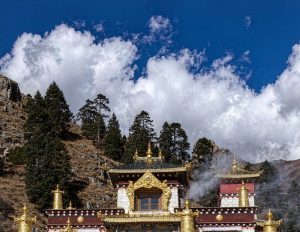
- Songzanlin Monastery, the largest Tibetan Buddhist monastery in Yunnan
- Dukezong old town and the world's largest prayer wheel
- Baima Snow Mountain pass at 4,292 m with its rhododendron forest
- Tibetan villages, mani stones and prayer flags throughout
- Pudacuo National Park's lakes and alpine pasture
Itinerary
-
1 Lijiang to Tiger Leaping Gorge
Lunch Tiger Leaping Gorge guesthouse08:00 - Departure: A two-hour drive north from Lijiang, climbing steadily as the valley narrows.
10:30 - Tiger Leaping Gorge: Where the Yangtze — the Jinsha here, before it turns east — is squeezed between the Jade Dragon and Haba Snow Mountains. The gorge runs 16 kilometres with a total drop of around 3,900 metres, making it one of the deepest in the world. The tiger of the name is said to have leapt the river at its narrowest point, where a rock in the middle breaks the current.
11:00 - The Upper Gorge: A staircase of more than 1,000 steps descends to the river. At the bottom the water comes through at such speed that the sound is physical and the spray rises several metres. The climb back up takes most people 45 minutes; horses are available for those who want them, and there is a viewing platform for anyone who prefers to stay on top.
13:30 - Lunch: At a guesthouse with a terrace over the gorge.
15:00 - Short walk: An optional hour on the upper trail toward the Middle Gorge, or rest at the guesthouse.
Important: This is the first night at altitude above 2,000 metres for most travellers. Take it slowly, drink plenty of water and skip the alcohol.
-
2 On to Shangri-La, Dukezong Old Town
Breakfast, Lunch Shangri-La, 4-star hotel09:00 - Departure: A two and a half hour drive northwest, climbing through Naxi and Yi villages into Tibetan country. Watch for the mani stones — piles of carved rock left by travellers — and the first prayer flags.
12:00 - Shangri-La: Arrival at 3,280 metres. The town was renamed from Zhongdian in 2001 on the strength of a claim that it was the Shangri-La of James Hilton's Lost Horizon, which is tourism marketing rather than fact. What is real is that this is the Tibetan cultural centre of northwestern Yunnan, and the surrounding valleys have been Tibetan for a thousand years.
12:30 - Lunch: Tibetan cooking — yak meat, butter tea, tsampa (roasted barley flour kneaded with butter), and the barley bread that is the regional staple.
15:00 - Dukezong old town: A Tibetan town on a hillside, largely rebuilt after a fire in 2014 but on the original street plan. The centrepiece, on the hill above, is the Guishan Temple's giant prayer wheel — around 60 tonnes and claimed as the largest in the world, turned by several people pushing together. The view from the temple terrace covers the whole town and the pasture beyond.
18:00 - Prayer-wheel circuit: We walk the kora with local residents, who do this every evening, spinning the smaller wheels along the way.
-
3 Songzanlin Monastery & Pudacuo National Park
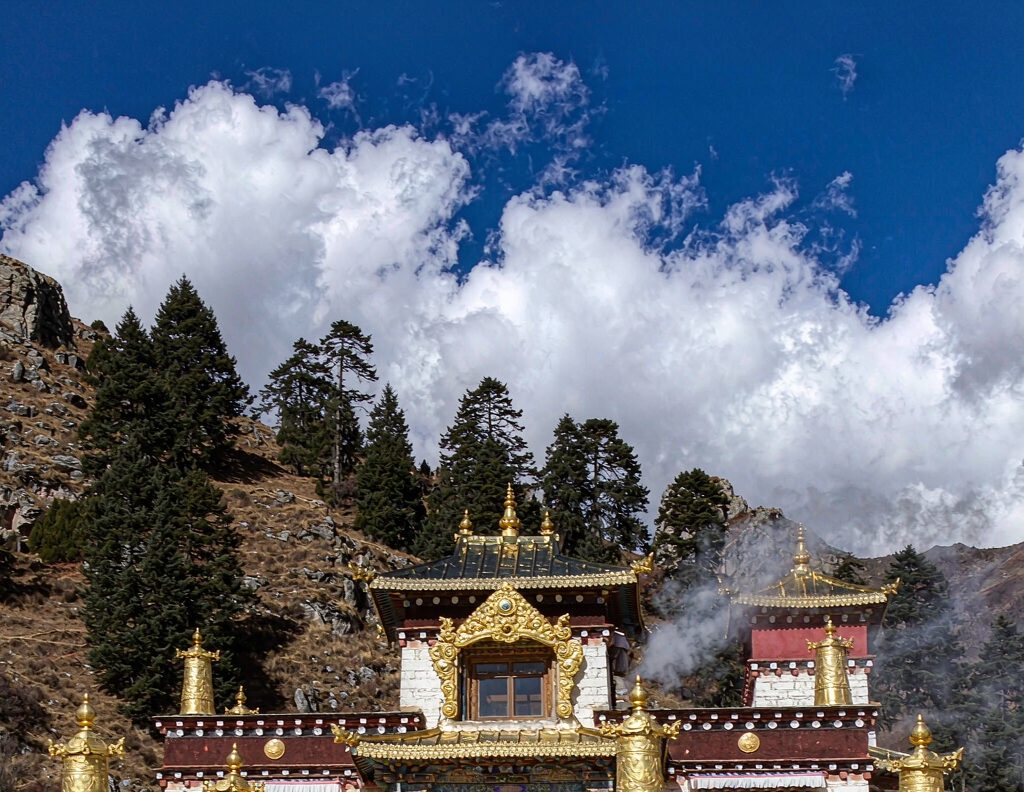
Breakfast, Lunch, Dinner (Tibetan home) Shangri-La, 4-star hotel08:30 - Songzanlin Monastery: Built in 1679 by the Fifth Dalai Lama on the model of the Potala and known as the Little Potala, this is the largest Tibetan Buddhist monastery in Yunnan and home to around 700 monks. The main hall holds a brass statue of Sakyamuni several storeys high, and the hillside around it is covered in monks' quarters, prayer wheels and the smoke of juniper offerings. We go early, when the morning ceremonies are under way and the light is low across the valley.
12:00 - Lunch: In town, or a simple meal at a monastery canteen if the schedule allows.
14:00 - Pudacuo National Park: China's first national park to be certified under international standards, at 3,500 to 4,200 metres. It protects lakes, alpine pasture and old-growth spruce and fir forest, and the boardwalks around Shudu Lake and Bita Lake are flat, well made and quiet. In June the azaleas come out across the meadows; in October the larch turns.
18:00 - Tibetan home dinner: In a village on the edge of town, in a house with a carved wooden interior and a stove that heats the whole room. Yak stew, butter tea, homemade barley wine and, if the family is in the mood, singing.
Important: Pudacuo is at serious altitude. Walk slowly, and tell your guide immediately about any headache or nausea.
-
4 Crossing Baima Snow Mountain to Feilaisi
Breakfast, Lunch Feilaisi, mountain guesthouse08:00 - Departure: The road west follows the old caravan route toward Tibet, climbing out of the Shangri-La basin.
10:00 - Baima Snow Mountain pass: The road crosses at 4,292 metres, the highest point of the trip. The slopes below the pass carry one of the richest rhododendron floras in the world — more than 200 species, some of them found nowhere else — and in late May and June the hillsides are covered in flower. We stop at the pass for the view back over the range.
12:30 - Lunch: In Deqin or a roadside Tibetan restaurant.
14:00 - Feilaisi: The village on the ridge opposite the Meili range, at 3,400 metres. It exists almost entirely because of the view. The terrace of white memorial stupas at the edge of the village is the classic foreground for the mountains.
15:00 - Mingyong Glacier or rest: Depending on the group, we either descend to the Mingyong Glacier — which flows down from Kawagarbo to within 2,700 metres of cultivation, one of the lowest-latitude glaciers on earth — or stay in the village and rest before tomorrow's early start.
Evening: Your guide checks the weather forecast and sets the alarm. If the morning is clear we are on the terrace by 06:30.
-
5 Meili Snow Mountain Sunrise & Return to Shangri-La
Breakfast, Lunch Shangri-La, 4-star hotel06:30 - Sunrise: The reason everyone comes. The Meili range runs north to south with Kawagarbo, the highest peak at 6,740 metres, at its centre. It is the first major peak to catch the sun, and for roughly three minutes the whole range turns from grey to pink to gold. It happens on maybe a third of mornings in the dry season and far fewer in summer — if you are in luck, it is one of the great sights of Asia. If the cloud is down, your guide will tell you honestly whether it is worth waiting.
08:00 - Breakfast at the guesthouse, watching the cloud.
09:00 - Departure: Retrace the road east over the Baima pass, with different light on the same mountains.
12:30 - Lunch en route.
16:00 - Return to Shangri-La: Check in and rest.
Evening: Free. Your guide can arrange a hot spring soak outside town, which is exactly what you will want after two days of mountain road.
-
6 Departure from Shangri-La
Breakfast Not includedMorning: Depending on your onward travel, a walk through the Songzanlin monastery's lower village, or the Shangri-La market where Tibetan farmers come in from the surrounding valleys to sell barley, yak products, wild mushrooms and hand-woven wool.
Late morning: Transfer to Diqing Shangri-La airport for onward flights (mostly to Kunming, Chengdu or Lijiang), or overland back to Lijiang — around four hours — if you are continuing by rail.
Practical note: Diqing airport is at 3,280 metres and flights are weather-dependent; afternoon fog can delay departures. If you have an international connection, we recommend routing back through Lijiang or Kunming and overnighting there instead.
Gallery
What's included
- 5 nights at 4-star hotels and Tibetan guesthouses
- Daily breakfast plus 4 lunches and 1 Tibetan home dinner
- English-speaking guide experienced at altitude
- Private 4WD vehicle with driver for the mountain roads
- All entrance fees listed (Tiger Leaping Gorge, Songzanlin, Pudacuo, Meili, Baima)
- Pudacuo National Park shuttle bus and boat
- Oxygen canisters and basic altitude medication carried by the guide
- Airport and station transfers
- All road tolls and parking
Not included
- Flights and trains to and from Lijiang or Shangri-La
- Most dinners
- Travel insurance — must cover altitude and mountain rescue
- Tips for guide and driver
- Personal expenses and hotel incidentals
- Optional horse riding at Tiger Leaping Gorge